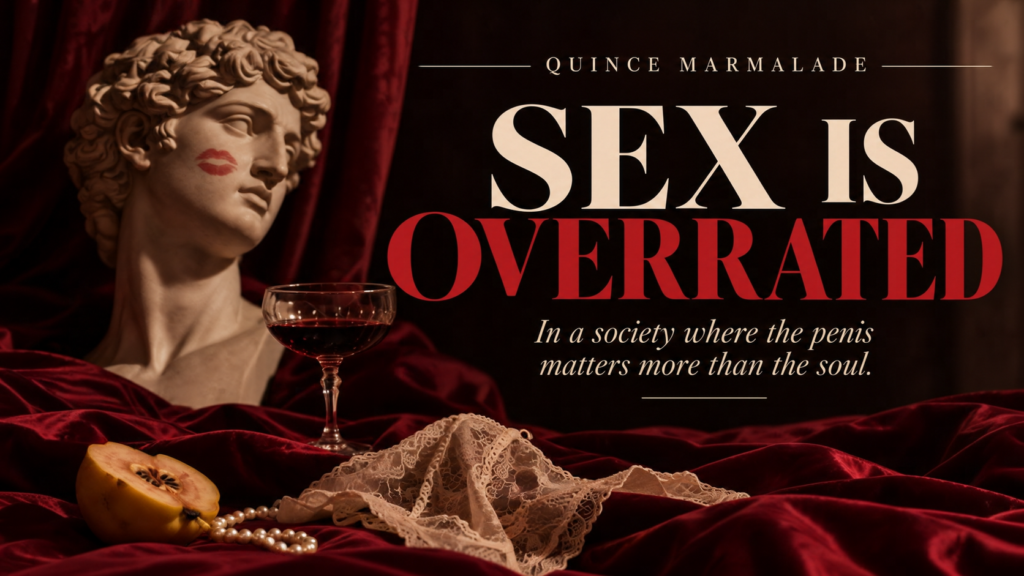
In a society where the penis matters more than the soul.
There is something rather uncomfortable about admitting this in a world so obsessed with sex, but perhaps it’s time we said it: sex is overrated.
Not because it isn’t beautiful. Not because pleasure is unimportant, or because human desire should be wrapped in shame. Quite the opposite. Sex can be extraordinary. It can be liberating, intimate, playful, tender, even transcendent.
But somewhere along the way, we’ve turned something natural into something almost sacred. We’ve made it a measure of success, a currency of validation, a performance of desirability, and, in many ways, a substitute for something far more meaningful.
We live in a society where you can be emotionally unavailable, intellectually uninspiring, spiritually bankrupt, and utterly incapable of holding a conversation beyond small talk, yet remain highly relevant as long as you’re sexually desirable.
The penis, it seems, has become more interesting than the person attached to it.
Literally.
We know who’s sleeping with whom, how often, what their preferences are, how many partners they’ve had, and what they’re capable of doing between the sheets. We have turned sexual biographies into social currency. Yet we rarely ask what keeps these people awake at night, what frightens them, what makes them cry, or whether they possess the emotional capacity to love someone without wanting to own them.
It’s as if a person’s sexual résumé has become more important than their human one.
And isn’t that a rather peculiar way to measure a life?
Sex as Social Currency
Sex has evolved into something much bigger than physical pleasure. It has become a social language, a status symbol, and, occasionally, an elaborate performance of self-worth.
For men, sexual conquests are still often presented as evidence of masculinity, power and social standing. The number of women becomes a measure of success, the number of encounters a source of validation, and sexual performance an extension of the male ego.
For women, the expectations are considerably more contradictory. Be desirable, but not too available. Be sexually liberated, but never too liberated. Be seductive, but maintain an air of mystery. Be wanted by everyone, but never appear to need the attention.
In other words, be a fantasy, but never admit that you have fantasies of your own.
Both genders, in their own ways, are participating in the same exhausting performance: the pursuit of desirability.
We don’t always have sex simply because we want to. Sometimes we do it to reassure ourselves that we’re still attractive. To avoid feeling lonely. To prove that we’re wanted. To collect another little piece of evidence that someone, somewhere, finds us worthy of attention.
But what happens when we remove sex as a measure of our value?
Who are we when nobody desires us?
Who are we when there is no one to touch us, impress us, or remind us that we are attractive?
And perhaps the most uncomfortable question of all: can we actually enjoy our own company without needing someone else’s body to make us feel alive?
An Abundance of Bodies, A Shortage of Intimacy
We live in an age of extraordinary access.
Access to people, photographs, profiles, fantasies, dating applications and seemingly endless possibilities. Finding someone to share a bed with has never been easier.
And yet, finding someone to share a life with seems increasingly complicated.
We have more sexual freedom, but not necessarily more emotional courage. We can send a naked photograph without hesitation, but struggle to write the words “I miss you”. We can discuss our sexual fantasies in great detail, yet become uncomfortable when asked what we actually need from another person.
We can share a bed with a stranger, but find it terrifying to let someone see our insecurities.
This is perhaps the great paradox of modern intimacy: the body is accessible, while the soul remains under lock and key.
Sex requires desire. Intimacy requires courage.
Sex can happen in a single night. Intimacy takes time, patience, and a certain willingness to be seen in all your imperfect glory. Sex can be a performance, carefully choreographed and executed. Intimacy, on the other hand, is impossible without presence.
And presence is something no amount of sexual technique can replace.
We have become remarkably comfortable with physical exposure and increasingly uncomfortable with emotional nakedness.
Perhaps because the latter leaves us with nowhere to hide.
The Cult of the Penis
Let’s talk about the penis.
In certain corners of contemporary culture, it has practically acquired the status of a religious institution. It is worshipped, discussed, compared, measured and treated as though it were the ultimate indicator of masculine worth.
Human sexuality is frequently reduced to centimetres, numbers, duration and performance. Sex has become something resembling a corporate KPI.
How many women or men? How many times? How long? How good?
Somewhere in this endless statistical exercise, a rather important question disappears:
Are you actually a good person?
Can you be gentle? Can you listen? Can you recognise someone else’s vulnerability without exploiting it? Can you be emotionally present without turning intimacy into a competition?
An erection is not a personality trait.
And the ability to physically satisfy someone is certainly no guarantee that you possess the ability to make them happy.
There is something deeply ironic about a culture obsessed with sexual potency while remaining almost entirely indifferent to emotional impotence.
A man can be sexually confident and emotionally helpless. He can know exactly what to do with a body and have absolutely no idea what to do with a feeling.
And this isn’t exclusively a male problem. We are all participating in a culture that often prefers being desired to being known.
Perhaps because being desired is flattering, while being known is frightening.
And What About the Soul?
Perhaps true intimacy is far less glamorous than we imagine.
It is seeing someone without the carefully constructed image, without the flattering lighting, without the performance. Seeing them in a bad mood, in moments of insecurity, in the uncomfortable silence that follows an argument.
It is being able to sit beside someone without feeling the need to entertain them.
It is not having to be beautiful, interesting, successful, seductive or amusing every minute of the day.
It is simply being human.
And perhaps that is the most erotic thing modern society has forgotten how to do: to be genuinely present with another person.
The soul has no filter. No algorithm. No carefully curated dating profile. You cannot impress it with six-pack abs, an expensive car, a perfectly styled outfit or a playlist designed to suggest emotional depth.
It asks for something considerably more complicated.
Authenticity.
It wants to know who you are when you have nothing to prove. What you believe in when nobody is watching. How you behave when you have nothing to gain. Whether you can stay when things become difficult, rather than disappearing the moment the excitement fades.
There is a particular kind of intimacy in being accepted without having to perform.
And perhaps we’ve become so accustomed to performing that we no longer recognise it when it finally arrives.
The Difference Between Being Wanted and Being Loved
There is a distinction we don’t discuss nearly enough: the difference between being wanted and being loved.
Being wanted can be intoxicating. It makes us feel attractive, powerful, interesting and alive. It feeds the ego in ways that are difficult to resist.
But being wanted is not the same as being understood.
Someone can desire your body without being interested in your mind. They can crave your presence without having the slightest intention of making space for you in their life. They can know exactly how to touch you and still have no idea how to treat you.
And perhaps the most dangerous thing we can do is mistake attention for affection.
We confuse chemistry with compatibility, attraction with connection, and physical intimacy with emotional commitment.
We become addicted to the feeling of being desired, sometimes forgetting to ask whether we are actually happy.
Because being someone’s fantasy can be wonderful, but it doesn’t necessarily mean you are someone’s safe place.
And what is the point of being endlessly desired if you are never truly seen?
Sex Is Overrated. Intimacy Isn’t.
I’m certainly not suggesting that we should stop having sex. Have sex. Enjoy it. Explore your desires. Be curious, adventurous, playful and free. There is absolutely nothing wrong with pleasure.
But perhaps we should stop pretending that sex is the highest form of human connection.
It isn’t.
Sometimes the most intimate moment you can share with someone has absolutely nothing to do with being naked.
Sometimes it is admitting that you’re afraid.
Sometimes it is staying when a conversation becomes uncomfortable.
Sometimes it is allowing someone to see the parts of you that aren’t particularly attractive, impressive or easy to love.
Sometimes it is simply being able to sit in silence with another person and feel no need to escape it.
Perhaps we should start measuring our relationships not by how many people we can attract, but by how many people can truly know us.
The world already has enough bodies.
What it desperately needs is more souls.
More conversations that don’t come with an expectation of sex. More affection that isn’t necessarily an invitation. More relationships in which we don’t have to constantly prove that we’re desirable in order to feel worthy.
More people who are interested in what happens inside our heads, not just what happens underneath our clothes.
Because, ultimately, the greatest luxury might not be having access to someone’s body.
It might be having access to their inner world.
Sex is overrated. Intimacy isn’t.
And if that sounds old-fashioned, perhaps the problem isn’t us, but the era we’ve found ourselves living in. An era in which we’ve become so preoccupied with being desired that we’ve forgotten the importance of being understood.
I don’t want to live in a world where everyone wants to sleep with me, but nobody wants to stay awake and talk to me.
Perhaps that’s the real intimacy crisis.
And perhaps it’s time we started talking about it.
