Digital Begging, Empty Fame, and the Society We’re Becoming
There was a time when becoming famous usually required something more than a smartphone and an internet connection. Talent, extraordinary achievement, creativity, or at least a compelling story often played a role.
Today, visibility itself has become a commodity.
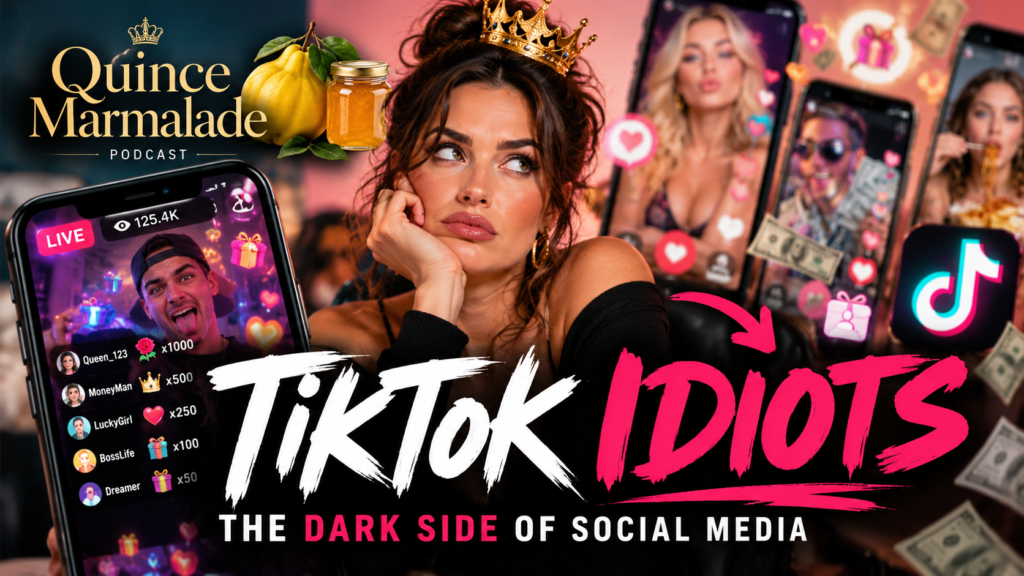
Across social media, and especially in certain corners of TikTok, attention is traded like currency, public embarrassment becomes entertainment, and digital gifts transform ordinary viewers into paying participants in spectacles that offer little beyond noise.
The problem is not that foolish entertainment exists. Human beings have always enjoyed absurdity, gossip, and spectacle.
The problem begins when we build an entire economy around rewarding emptiness and then mistake the resulting popularity for genuine value.
Famous for Absolutely Nothing
Social media has dramatically changed the meaning of celebrity.
The traditional connection between public recognition and achievement was never perfect. Nevertheless, the modern influencer economy has made it possible to acquire enormous visibility without demonstrating expertise, creativity, or any particularly meaningful contribution.
Some creators build successful communities around education, artistry, humor, or genuine entertainment. Others rely almost entirely on provocation, conflict, self-promotion, and carefully manufactured drama.
Both can attract large audiences.
This reveals a fundamental problem with the way we understand popularity.
Attention is not evidence of intelligence. Visibility is not evidence of achievement. And influence is not evidence of wisdom.
Yet younger audiences are constantly exposed to the idea that being noticed is an accomplishment in itself.
The question “What do you want to become?” increasingly competes with a very different ambition: “How do I become famous?”
The distinction matters.
Becoming a doctor, an engineer, an artist, or a teacher involves developing abilities that exist independently of public applause. Becoming an internet personality can involve meaningful work, but fame alone does not guarantee meaningful achievement.
A society that confuses recognition with accomplishment risks teaching people to pursue the appearance of success rather than its substance.
Digital Begging: When Attention Has a Price Tag
Perhaps one of the strangest developments in online entertainment is the rise of virtual gifting during livestreams.
Viewers purchase digital items with real money and send them to creators. These gifts can function as appreciation, financial support, or participation in livestream competitions.
There is nothing inherently wrong with financially supporting content that brings genuine value or enjoyment.
The more troubling phenomenon emerges when gifting becomes a form of social pressure, emotional manipulation, or purchased recognition.
Some livestreams revolve almost entirely around asking viewers to send gifts. The creator’s main performance becomes encouraging financial contributions, while the audience competes for acknowledgment, status, or perceived belonging.
What does a viewer actually receive?
Perhaps their username is mentioned. Perhaps the creator thanks them. Perhaps they briefly become visible in a crowded digital room.
Then the moment disappears.
This is where the boundary between entertainment and digital begging becomes increasingly blurred.
The issue is not simply spending money online. People spend money on entertainment in countless forms.
The issue is whether viewers understand what motivates their spending.
Are they genuinely enjoying the content? Are they supporting somebody’s creative work? Or are they purchasing the illusion of personal importance?
When human connection begins to resemble a transaction, attention becomes a product and loneliness becomes a potential market.
TikTok Battles: The New Digital Arena
TikTok battles provide a revealing example of how competition, entertainment, and monetization can merge.
Two creators compete during a livestream, while viewers send gifts that contribute to their scores.
These competitions can be playful and entertaining. But some become aggressive performances of rivalry, shouting, humiliation, and relentless demands for contributions.
The similarities to historical spectacles are difficult to ignore.
Ancient societies gathered in arenas to witness public contests. Modern audiences participate through screens, comments, and digital payments.
The comparison is metaphorical, not literal. Yet the underlying attraction to rivalry, winners, losers, and collective excitement remains recognizable.
What makes modern digital battles particularly interesting is the audience’s direct financial participation.
The spectators are not merely watching the spectacle. They are helping fund it.
And the more emotionally invested they become, the greater the incentive to contribute.
This raises a question that deserves more attention: when does harmless entertainment become a system designed to encourage people to spend money on contests with no lasting significance?
The Algorithm Doesn’t Care About Your Intelligence
Social media recommendation systems are sophisticated tools for predicting what users are likely to watch, enjoy, share, or engage with.
But engagement is not the same as educational value.
A thoughtful analysis of a complicated issue might demand patience and concentration. A provocative argument, absurd performance, or emotionally charged video can capture attention almost instantly.
Both may perform well, depending on the audience and the system.
The underlying concern is not that an algorithm deliberately seeks to make people less intelligent. Such a claim would be misleading.
The concern is that commercial optimization for attention does not automatically produce an environment optimized for learning, reflection, or intellectual development.
Outrage can be engaging. Conflict can be engaging. Sensationalism can be engaging.
And when attention is economically valuable, creators may be rewarded for producing whatever attracts and retains it.
A culture increasingly shaped by these incentives may begin to favor immediate emotional reactions over careful examination.
The result is not necessarily a less intelligent population. It is a media environment where depth must compete against speed, complexity against simplicity, and careful thought against spectacle.
We Are Raising Spectators, Not Thinkers
Perhaps the most significant concern is not what adults watch today, but what younger generations learn to value tomorrow.
Children are growing up surrounded by content that encourages constant consumption, comparison, reaction, and public self-presentation.
They can access extraordinary educational resources, creative tools, and global communities. These are real benefits that should not be ignored.
At the same time, endless streams of short videos can make passive consumption extremely convenient.
The danger lies in allowing consumption to replace curiosity.
Watching content is not the same as understanding it.
Having access to information is not the same as developing knowledge.
Repeating an opinion is not the same as thinking critically.
Critical thinking requires patience, the willingness to question assumptions, and the ability to tolerate uncertainty.
These qualities cannot be reduced to engagement statistics.
There is no simple scientific basis for claiming that TikTok alone is making an entire generation less intelligent. But it is reasonable to question how digital habits influence attention, learning routines, and the way young people understand achievement.
If children repeatedly encounter a world where loudness earns visibility and superficial popularity earns money, what conclusions might they draw about success?
More importantly, what alternatives are adults offering them?
Education should not merely teach young people to consume information.
It should teach them to evaluate information, challenge weak arguments, create meaningful work, and recognize the difference between confidence and competence.
We don’t need a generation that knows how to follow everybody. We need one that knows when to think independently.
The Economy of Artificial Perfection
Beyond battles and virtual gifting lies another pervasive problem: the commercialization of appearances.
Influencers can construct carefully edited identities built around luxury, physical beauty, happiness, and apparent success.
The audience sees expensive holidays, perfect relationships, fashionable lifestyles, and endless confidence.
What remains hidden may include financial pressure, insecurity, ordinary responsibilities, and the less glamorous realities of daily life.
This imbalance creates an environment where viewers compare their unedited existence with somebody else’s curated presentation.
The result can be a distorted understanding of what success and happiness actually look like.
A luxury lifestyle on a screen does not prove financial security. A perfect relationship in a video does not prove emotional intimacy. A confident public persona does not necessarily indicate personal stability.
The more value we place on appearances, the easier it becomes to overlook the substance behind them.
Authenticity becomes a marketing strategy.
Happiness becomes content.
And success becomes something people are encouraged to display rather than experience.
The Audience Is Part of the Problem
Criticizing creators is easy.
But the uncomfortable truth is that creators respond to incentives shaped by audiences and platforms.
Every view, comment, share, and purchase communicates something about what attracts attention.
If outrageous behavior consistently generates engagement, more people may imitate it.
If public conflict becomes profitable, conflict can become a recurring product.
If viewers reward empty spectacle, empty spectacle becomes commercially viable.
The responsibility is shared.
Platforms shape the conditions under which content circulates. Creators decide what they produce. Audiences choose what they support, although those choices are influenced by recommendation systems and design.
No single group controls the outcome completely.
But everyone participates in the system.
This is why mocking individual TikTok personalities misses the larger issue.
The central question is not why some people behave foolishly online.
It is why our digital economy can make foolishness so financially attractive.
The Most Valuable Currency Is Not Money
The financial cost of virtual gifts is easy to understand.
The cost of attention is more difficult to measure.
Time spent online is not automatically wasted. Entertainment, laughter, friendship, and relaxation have legitimate value.
However, there is a meaningful difference between consciously choosing entertainment and compulsively consuming content long after it has stopped being enjoyable.
Hours can disappear into endless scrolling, artificial controversies, manufactured conflicts, and lives that have little connection to our own.
What could that time have been used for?
Reading. Learning. Creating. Building relationships. Developing skills. Resting without a screen.
The point is not to turn every minute into a productivity exercise.
The point is to recognize that attention is limited.
And unlike money, time cannot be earned back.
Conclusion: The Mirror We Don’t Want to Look Into
It would be convenient to blame TikTok for the superficiality of modern culture.
But that would be too simple.
TikTok did not invent vanity, ignorance, celebrity worship, or the human fascination with spectacle.
It has created new ways to distribute, amplify, and monetize behaviors that have existed for centuries.
The deeper problem is cultural.
We have become remarkably comfortable rewarding visibility without examining value.
We celebrate influence without always questioning its direction.
We purchase digital symbols of recognition while sometimes neglecting the more demanding work of building meaningful connections and fulfilling lives.
And we increasingly allow recommendation systems to shape what occupies our minds.
Technology is not inherently the enemy of intelligence.
But neither is technological progress a guarantee of cultural progress.
The responsibility ultimately returns to us.
What do we choose to watch?
Who do we choose to support?
What behaviors do we reward?
And what are we teaching the next generation about what deserves admiration?
Perhaps the real tragedy of digital culture is not that some people have become famous for absolutely nothing.
Perhaps it is that so many others have become willing to give them the most valuable things they possess.
Their attention.
Their money.
And their time.
The greatest danger is not that the world will run out of intelligent people.
It is that we may become so comfortable celebrating ignorance that we stop recognizing the value of intelligence.
